

Guide7 min read

How Does a DCF Work? A Plain-English Guide

The Intrinsiqq Team
SEC-data stock analysis · May 27, 2026 · Updated June 3, 2026
Guide
Intrinsiqq

A discounted cash flow (DCF) estimates what a business is worth today by projecting the cash it will generate in the future and discounting that cash back to the present. The logic: a dollar earned years from now is worth less than a dollar today, so future cash flows are "discounted" to a present value. Add them up and you get an estimate of intrinsic value. Here is how it works, in plain English, including the inputs that move the answer the most.

The four steps of a DCF

  • 1. Start with free cash flow.Begin from the company's most recent annual free cash flow (operating cash flow minus capital spending), the real cash the business throws off after keeping the lights on.
  • 2. Project it forward. Grow that cash flow over the next several years at a chosen growth rate, usually fading to a slower rate as the company matures.
  • 3. Add a terminal value. Estimate the value of all cash flows beyond the projection window, growing at a small perpetual rate. This often makes up the majority of the total value.
  • 4. Discount everything to today. Bring each future cash flow back to present value using a discount rate (the WACC), then sum them, add cash, subtract debt, and divide by shares to get a per-share intrinsic value.

Why a two-stage model

Real companies do not grow at one constant rate forever. A two-stage DCF uses a higher near-term growth rate for the first few years, then fades to a lower rate, which is far more realistic than assuming a single rate. The Intrinsiqq DCF is a two-stage model you can adjust yourself.
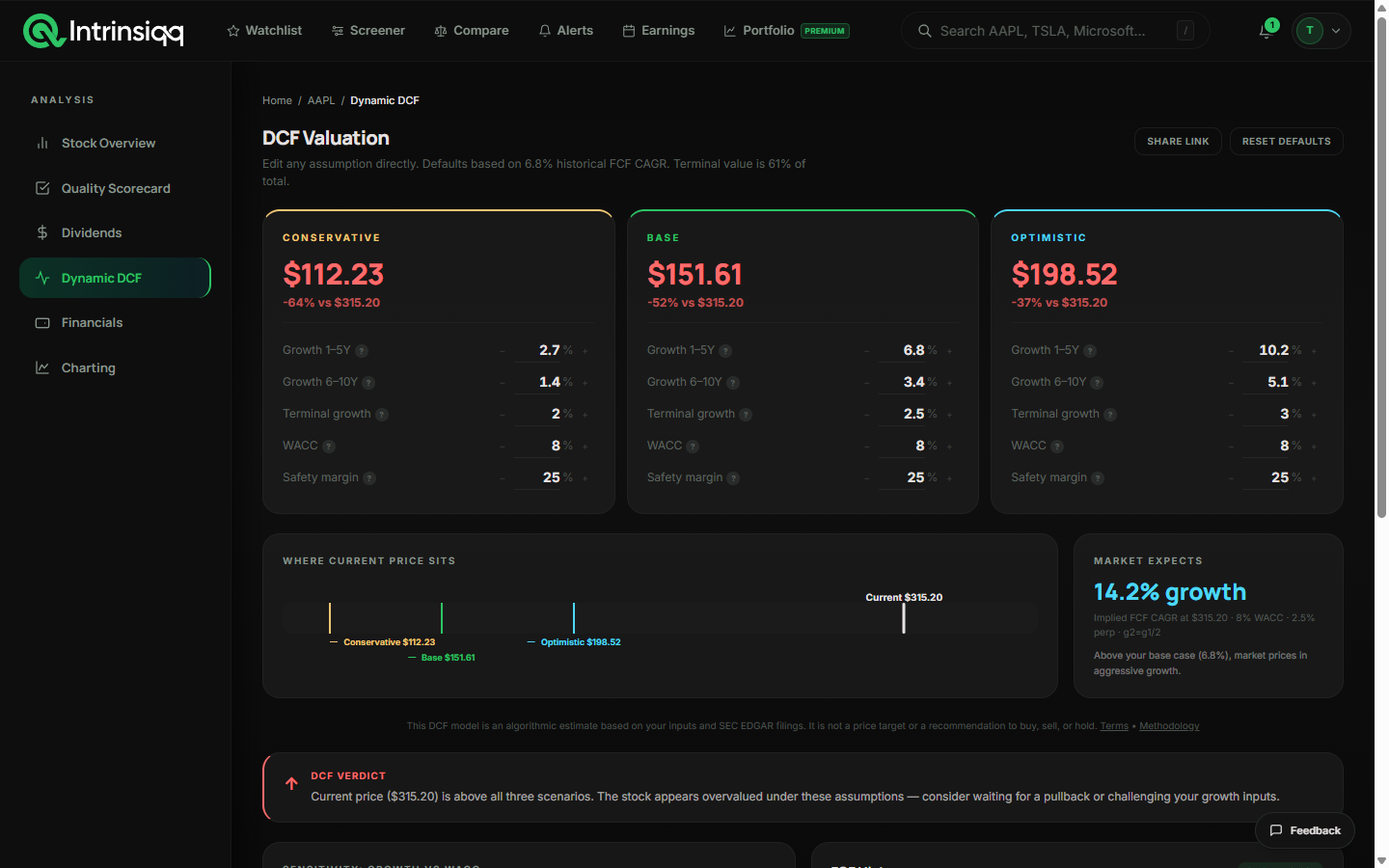
Intrinsiqq two-stage DCF for Apple showing conservative, base, and optimistic intrinsic values with adjustable growth, WACC, and terminal-growth inputs
A worked two-stage DCF: near-term growth, a fade rate, a discount rate (WACC), and terminal growth, run across three scenarios.

The inputs that move the answer

A DCF is only as good as its assumptions, and a few of them do most of the work. This is the table to keep in mind:

InputWhat it isEffect on the value
Starting free cash flowThe most recent annual FCFThe base everything else grows from
Near-term growthGrowth for the first stage (e.g. years 1-5)Higher growth, higher value; be conservative
Fade growthSlower growth for the later stageBridges high growth to maturity
Terminal growthPerpetual growth after the windowSmall changes have an outsized effect on the total
Discount rate (WACC)The required annual returnHigher rate, lower value; reflects uncertainty
A DCF is extremely sensitive to these assumptions. That is a feature, not a flaw: it shows you exactly what growth the current price requires. Run bull, base, and bear cases rather than trusting one number.

Because everything grows from the starting free cash flow, it is worth seeing how steady that base is. On Intrinsiqq you can chart a company's free cash flow over a decade before you model it forward, so a single flattered or depressed year does not quietly skew the whole valuation.

See a worked DCF on a real stock

Financials pre-loaded from SEC filings; adjust the growth and discount rate and watch the fair value change.

Open AAPL's DCF

What a DCF can and cannot tell you

A DCF is a disciplined way to connect a price to the cash a business must produce to justify it. What it cannot do is predict the future: garbage assumptions in, garbage value out, and the terminal value in particular can dominate the result. The right way to use it is less "what is the exact fair value" and more "what does today's price assume, and is that believable?" Use it alongside a quality assessment so you are valuing a business you actually understand, and read our guide on telling if a stock is overvalued for how the DCF fits with valuation multiples.

Frequently asked questions

What is a DCF in simple terms?+

A discounted cash flow (DCF) estimates what a business is worth today by projecting its future free cash flow and discounting it back to the present, because a dollar in the future is worth less than a dollar today. You start from the company's current free cash flow, grow it over several years (usually fading to a slower rate), add a terminal value for everything beyond that window, discount it all to today using a required rate of return, then adjust for cash and debt and divide by shares. The result is an estimate of the company's intrinsic value per share.

What is the discount rate in a DCF?+

The discount rate (often the WACC, weighted average cost of capital) is the minimum annual return an investor demands. It converts future cash flows into today's value: the higher the rate, the less those future cash flows are worth now. A higher discount rate therefore lowers the estimated intrinsic value and reflects greater uncertainty or risk. Choosing it is partly judgement; many investors use a rate in the high single digits to low double digits for a typical stock and raise it for riskier, less predictable businesses.

Why do DCF values vary so much?+

A DCF is highly sensitive to its growth and discount-rate assumptions, and especially to the terminal growth rate, which values cash flows into perpetuity and often makes up most of the total. Small changes in any of these inputs produce large swings in the output. That sensitivity is why a DCF is best used to compare scenarios (bull, base, and bear) and to see what growth the current price already implies, rather than to produce a single precise target you treat as fact.

What is a good growth rate to use in a DCF?+

There is no universal number; it should reflect the specific business and be conservative. A useful anchor is the company's own historical revenue and free-cash-flow growth, adjusted down for the fact that high growth rarely lasts. For the near-term stage you might use something close to recent growth, fading to a long-run rate, and for terminal growth most analysts use a low figure near long-run economic or inflation growth (often around 2-3%), because no company can grow faster than the economy forever. Always test how the value changes when you flex these assumptions.

The Intrinsiqq TeamSEC-data stock analysis

Intrinsiqq builds free stock analysis from official SEC EDGAR filings: quality scores, DCF fair value, dividend safety, and 10 years of financials for 8,000+ US companies. Every number is computed from primary filings and documented in full on our methodology page, not from third-party estimates. Read the methodology →

Intrinsiqq is a research tool, not investment advice. Figures are computed from public SEC EDGAR filings; stock prices are delayed. Always do your own research before making any investment decision. Product names and logos are trademarks of their respective owners; Intrinsiqq is independent and not affiliated with or endorsed by them.

Related articles