

A high-quality company is one that earns strong returns on the money it invests, grows, and can sustain both without piling on debt or diluting shareholders. You can judge quality from a handful of fundamentals: growth, margins, returns on capital, the balance sheet, and the share count. Here is what to look for, the healthy sign for each, and how the Intrinsiqq quality score combines them into one 0-100 number.
The fundamentals that signal quality
No single metric makes a company high quality; you are looking for a pattern across several. These are the checks that matter most and the healthy sign for each:
| Check | What it rewards | Healthy sign |
|---|---|---|
| Revenue growth (5Y) | A growing top line | Compound growth above ~10% |
| Free cash flow growth (5Y) | Growth showing up in real cash | FCF compounding, not just revenue |
| Operating margin trend (3Y) | Pricing power and discipline | Margins flat to expanding |
| Return on invested capital | Turning capital into profit | Consistently high (roughly 15-20%+) |
| Capital structure | Balance-sheet resilience | Low net debt vs free cash flow, or net cash |
| Share dilution | Per-share growth being real | Flat or falling share count |
| P/E and P/FCF | Not overpaying for it | Reasonable relative to the growth |
The standouts are return on invested capital (ROIC), the single best quality signal, because a consistently high ROIC means the company turns invested money into strong profits, and free cash flow growth, because it confirms the growth is real cash, not just accounting revenue. A flat or falling share count matters more than people realise: steady dilution quietly erodes your stake even when the business is growing.
How Intrinsiqq scores quality
The Intrinsiqq quality score is a 0-100 weighted composite of eight checks: P/E, P/FCF, 5-year revenue growth, 5-year free cash flow growth, share dilution, 3-year margin expansion, capital structure, and ROIC. Each produces its own sub-score, and the weighting leans toward the cash-flow and returns measures that best separate durable businesses from fragile ones. Every input is computed from SEC EDGAR filings, so the picture reflects what the company actually reported, not estimates.
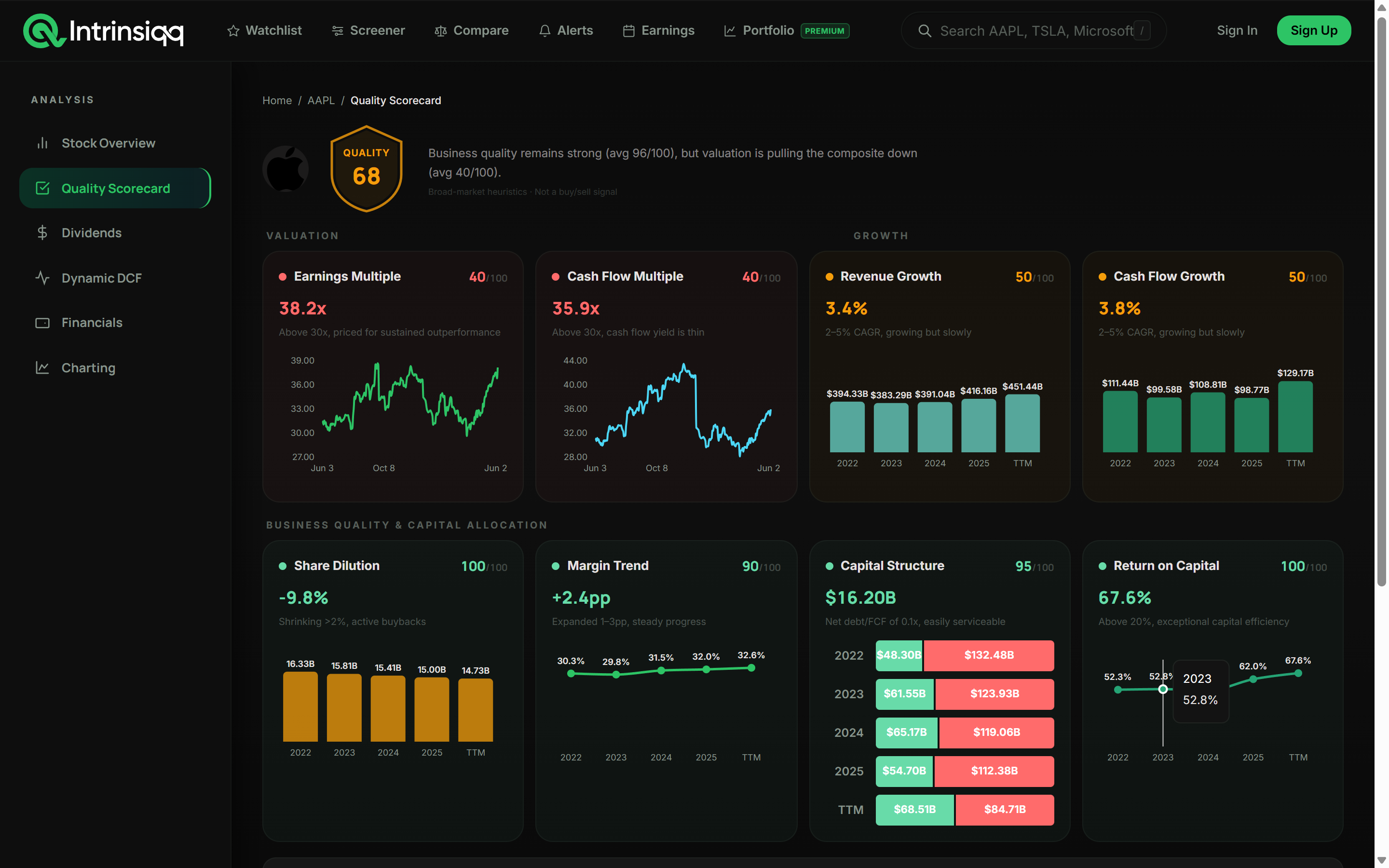
Because quality is a pattern over time, not a single snapshot, it helps to chart these fundamentals rather than read one year in isolation. Intrinsiqq's fundamental charting plots revenue and free cash flow growth, operating margins, ROIC, debt, and the share count over up to a decade, so you can see whether the trend is improving or quietly deteriorating, which is exactly what separates a durable business from a fragile one.
Check any company's quality, free
A 0-100 quality score from eight fundamental checks, computed from SEC filings.
Check MSFT's qualityPutting it together
Look for the pattern: durable growth, solid and improving margins, high returns on capital, a sound balance sheet, and no creeping dilution. When most of those line up, you are looking at a quality business, and then the only remaining question is whether it is fairly priced. A great business at a great price is the goal; a great business at any price, or a mediocre business at a discount, usually is not.