

I still have Yahoo Finance open most mornings. It is a good portal. What it never did was answer the question I actually had, which was whether the company I was looking at was any good and whether I was overpaying. For that I kept ending up back in a spreadsheet. If that sounds familiar, here is what I moved to instead, and where Yahoo is still the better tool.
What Yahoo is genuinely good at
Worth being fair about this before pulling it apart. Yahoo Finance is free, it covers almost every listed security on earth, the watchlist works, the news feed is fast, and it gives you analyst estimates that most free tools do not. For keeping half an eye on the market it is hard to beat, and I have not stopped using it.
There is also a paid tier now, which tells you where the company thinks the value is: real-time data, more history, portfolio analytics. Fine, but none of that is the thing I was missing.
Where it stopped being useful to me
The financials tab gives you a few years of numbers in a table. That is data, not analysis. Nothing on the page tells you whether margins have been holding, whether the balance sheet would survive a bad year, or whether any of it has been consistent for a decade. You are handed the raw inputs and left to do the work, which is fine if you were going to open a spreadsheet anyway, and useless if you wanted an answer in ten seconds.
And there is no valuation. Analyst price targets are not a valuation, they are other people's opinions averaged together. I wanted to know what the business was worth on cash flows I could see, with assumptions I could inspect.
How we compared these
Disclosure first: Intrinsiqq is mine, so treat my verdict on it accordingly. What I can tell you is how it is built, because I built it, and the method behind every number is published in full so you can check the claims rather than take them.
For the others I worked from their free tiers and their own published pricing pages rather than buying a subscription to each. That is enough to establish what is gated and what is not, which is what this article is about. Where I could not verify something without paying, I say so.
Every tool was judged on the same questions:
- →What you get without paying, as opposed to a trial or a teaser
- →Whether it answers the two questions that matter: good business, fair price
- →Where the underlying numbers come from
- →How much history you get on the free plan
- →Whether the page is usable or buried in ads
Competitor plans and features last verified 30 July 2026. Pricing and free tiers change often, so check the source before relying on any figure here.
The alternatives, compared
| Tool | Quotes / news | Quality score | Fair value | Financials (free) | Screener | Ads |
|---|---|---|---|---|---|---|
| Intrinsiqq | Basic | Yes (0-100) | Yes, 2-stage DCF | 5 yrs (10+ paid) | Paid | None |
| Yahoo Finance | Yes, broad | No | No | A few years | Basic | Yes |
| Stock Analysis | Some | No | No | 5 yrs (10 Pro) | Yes | Mostly none |
| Finviz | Headlines | No | No | Snapshot | Yes, strong | Yes |
| Google Finance | Yes, simple | No | No | Basic | No | No |
The three I actually rate
Intrinsiqq, for the verdict Yahoo does not give
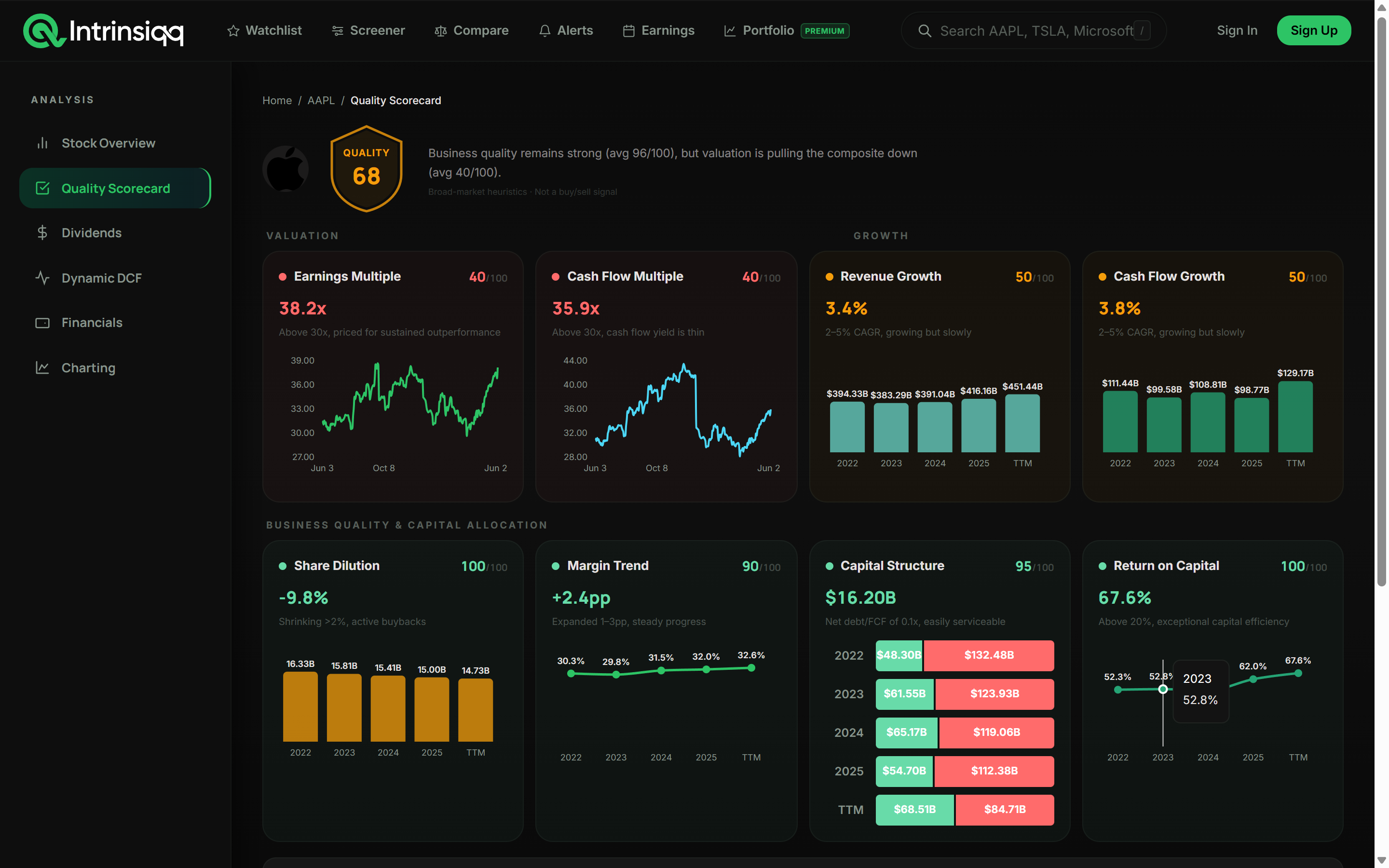
This is the part Yahoo leaves out, so it is the part I built. Open any stock and you get a quality score from eight checks, a two-stage DCF fair value, dividend safety, and the financial history behind all of it, computed from SEC filings rather than an aggregator. No ads, and you do not need an account to look at a stock.
Being straight about the free line, since this is an article about free tools: the quality score, the base fair value, dividend safety, five years of financials and basic charting are free. Adjusting the DCF assumptions yourself, the screener, comparing stocks side by side and the deeper history are paid, though every new account gets all of it for fourteen days.
Strengths
- +Answers 'good business?' and 'fair price?' in one screen
- +Every figure traces back to a filing, and the method is published
- +No ads, no account needed to analyse a stock
Limitations
- ×Not a news or quotes portal, and not trying to be
- ×End-of-day prices, not real-time
- ×Non-US fundamentals come from a data provider rather than filings
Stock Analysis, for reading the statements
If your main gripe with Yahoo is that the financials tab is cramped and cluttered, this is the straight upgrade. Clean multi-year statements, sensible ratios, a decent free screener, no account required. It is data-first, so it will not tell you what to think, which is either the point or the problem depending on what you came for.
Finviz, for screening and the map
Finviz is what I use when I do not have a specific company in mind. The free screener is genuinely strong and the heatmap is the fastest way to see what the market did today. It is ad-supported and the interface looks like it was built in 2007, which I have come to find reassuring.
Google Finance, briefly
Clean, quick, almost no ads, and shallower than Yahoo on everything. Worth knowing about if all you want is a price and a watchlist.
Look up a stock without the ads
Quality score, fair value and dividend safety, computed from SEC filings. No account needed.
Try it on AAPLWhat I actually do now
I did not replace Yahoo. I stopped asking it to do a job it was never built for. These days Yahoo is still where I check news and prices, Finviz is where I go looking for ideas, and Intrinsiqq is where I decide whether a company is worth owning. If you only want to change one thing, change the last one, because that is the decision the money rests on.
- Quotes, news, a watchlist: stay on Yahoo, or Google Finance if the ads bother you.
- Is this a good business, and is it cheap: Intrinsiqq.
- Statements without the clutter: Stock Analysis.
- Finding something to look at in the first place: Finviz.